Augusto de Campos | pós poemas
Luciana Brito Galeria is opening its 2026 program with two exhibitions: pós poemas [post-poems], by Augusto de Campos, one of the leading figures of concrete and experimental poetry in Brazil, and Ainda Bem, Atravessei as Nuvens [It’s Good That I’m Past the Clouds] Gabriela Machado’s second exhibition at the gallery. Augusto de Campos’s exhibition is based on his book of the same title – his most recent publication, described by the artist as “my last book of poems,” while Gabriela Machado is presenting a selection of paintings produced between 2024 and 2026.
Modernist Room
Exhibition: Augusto de Campos – pós poemas
Opening: February 5, 2026
On view through March 7
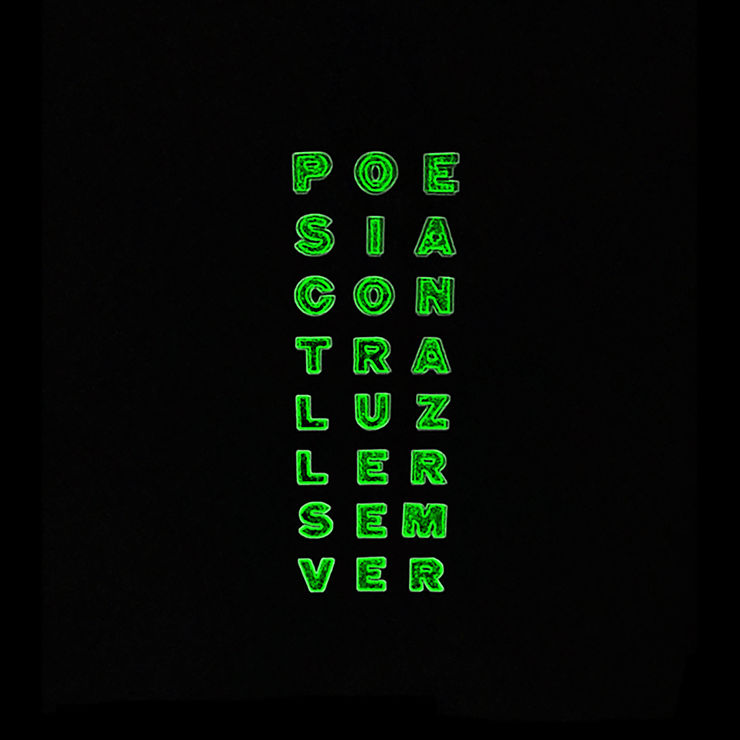
As he approaches his 95th birthday, Augusto de Campos has recently published the book pós poemas, which presents a body of work understood as a landmark synthesis of the evolution of his poetic research. Produced over the past two decades, the works in the volume have given rise to a selection now transposed into the gallery’s Modernist Room, proposing an experience that is not only visual but also spatial, in dialogue with the environment designed by Rino Levi. In the exhibition setting, the poems cease to function solely as objects of reading and assert themselves as visual and spatial experiences: letters become images, colors take on semantic roles, and the graphic arrangement establishes rhythms and tensions that draw the viewer into active perceptual engagement.
Augusto de Campos’s poetry is not organized around the linear progression of the verse, but rather through visual and sonic fields of force that challenge conventional reading. Resulting from a process the poet began in the 1950s, these works present a verbivocovisual structure characteristic of Concrete poetry – in which word, sound, color, and form are intrinsically interconnected. Nevertheless, their composition relies on 21st-century graphic and digital resources. Beyond the broad technological possibilities offered by computer graphics – which the artist has been using since the early 1990s – Augusto de Campos also experiments with elements drawn from his immediate context, including ideogrammatic structures and mathematical logic, intertextual procedures that reference Marcel Duchamp, James Joyce, and Fernando Pessoa, and strategies associated with the concept of the “ready-made.”
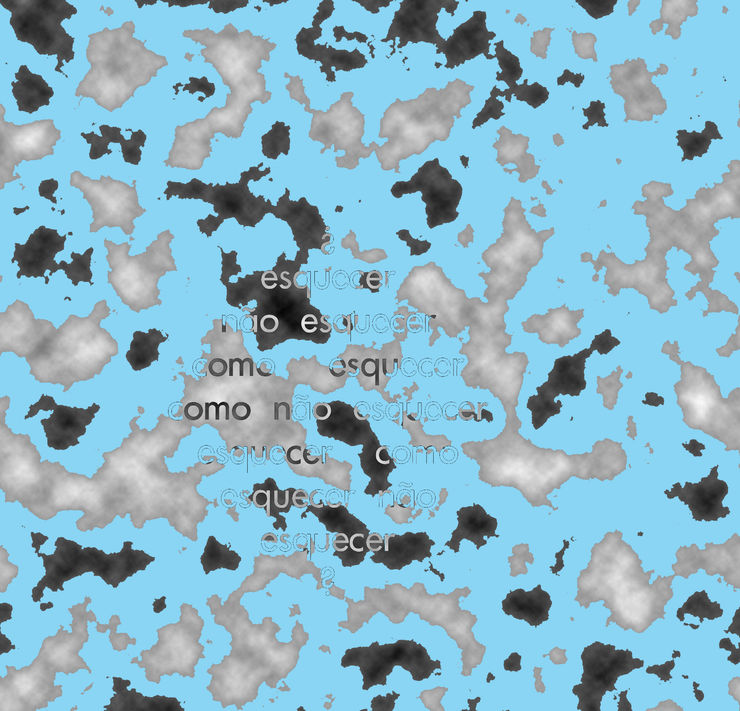
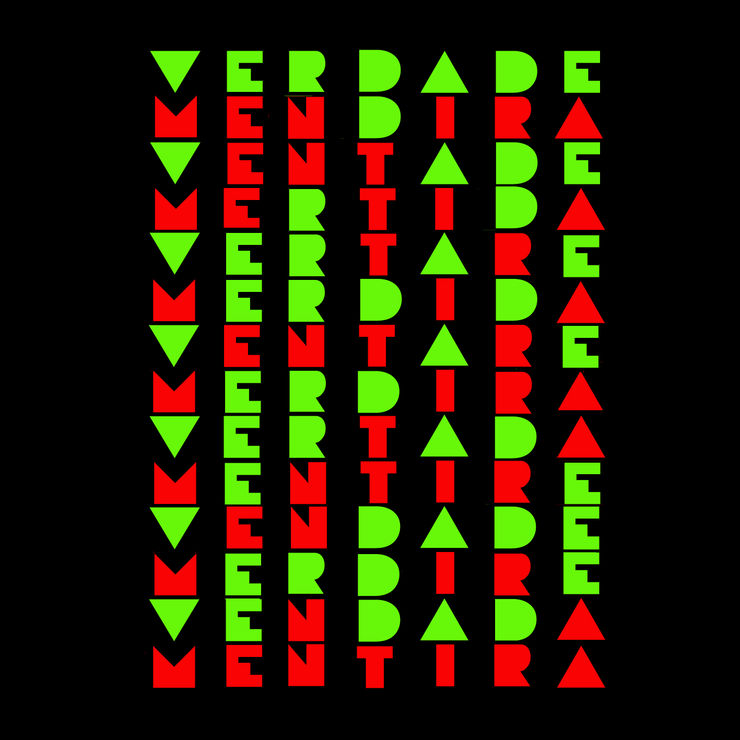
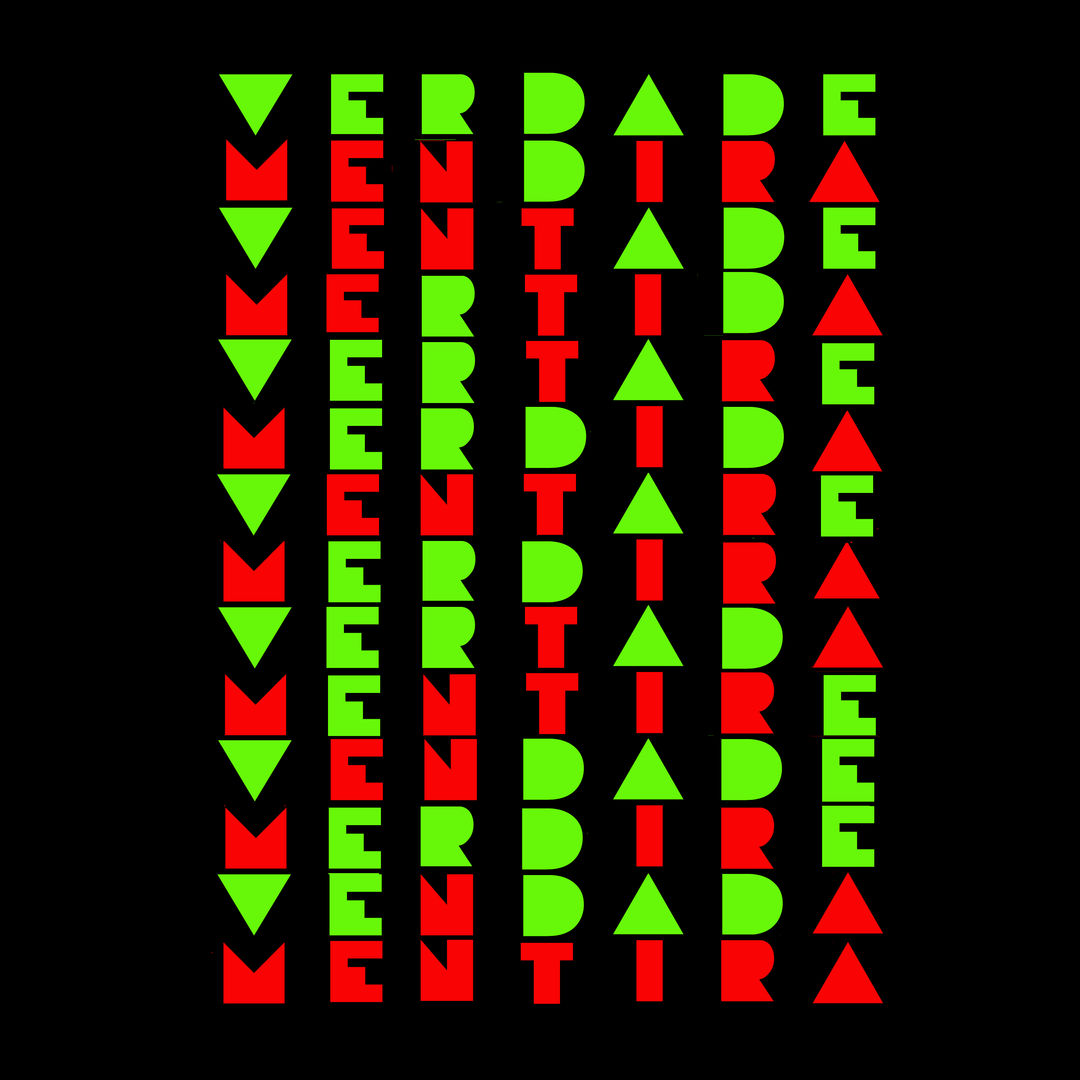
Esquecer (2017) and Vertade (2021) call for a highly attentive nonlinear reading that is perceptual, almost physical. In Vertade, Augusto de Campos tricks the gaze by swapping the letters D and T in the antonyms verdade [truth] and mentira [lie], creating a semantic short-circuit that jolts the viewer’s trust in conventional reading. In Esquecer [meaning to forget] the artist enacts the progressive loss of words from a preexisting poem, retrieved and placed over the surface of a cloudy sky. As the words pass through the clouds, they fade and merge with the image, producing an effect of visual erasure that becomes a sensitive reflection on memory, forgetting, and time. Time, in turn, is also a central reference in the exhibition’s title, pós poemas, in which the term “pós” bears a semantic duality: it conveys both the meaning of “after” and the plural of “pó” [dust] – the material vestige of what once was.