-
Luciana Brito galeria
SP-ARTE Rotas 2026
Booth
C8
Afonso Tostes | ANTONIO PICHILLÁ | Bosco Sodi
caio reisewitz | Delson Uchôa | Eder Santos
Fabiana de Barros | Fernando Zarif | Gabriela Machado
Iván Navarro | Leandro Erlich | Liliana Porter
Marcia Grostein | Tiago Tebet
-
Luciana Brito Galeria will be taking part in the upcoming edition of SP-Arte Rotas with a se-lection of works by artists from different generations and trajectories, presenting a panorama of practices that span recent decades and reflect the diversity and complexity of Latin Ameri-can artistic production – Afonso Tostes (b. 1965, Brazil), Antonio Pichillá (b. 1982, Guatema-la), Bosco Sodi (b. 1970, Mexico), Caio Reisewitz (b. 1967, Brazil), Eder Santos (b. 1960, Bra-zil), Delson Uchôa (b. 1956, Brazil), Fabiana de Barros (b. 1957, Brazil), Fernando Zarif (1960–2010, Brazil), Gabriela Machado (b. 1960, Brazil), Iván Navarro (b. 1972, Chile), Leandro Erlich (b. 1973, Argentina), Liliana Porter (b. 1941, Argentina), and Tiago Tebet (b. 1986, Brazil). Guest artist: Marcia Grostein (b. 1949, Brazil).
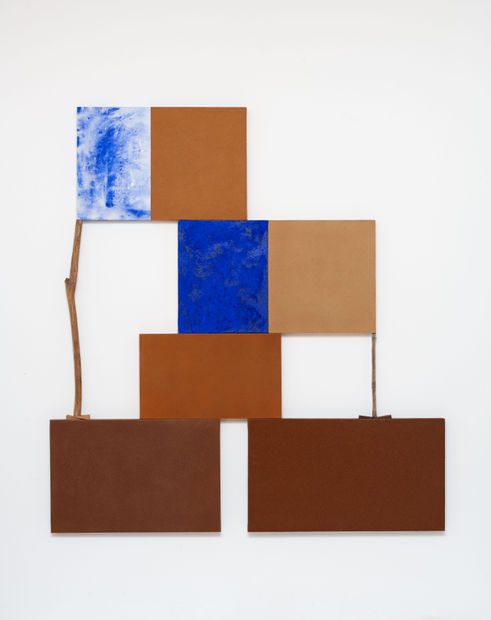
The selection as a whole highlights different approaches to the possibilities of artistic prac-tice, bringing into dialogue bodies of research that, while distinct, share an interest in exper-imentation and in constructing new forms of perception. Through photography, Caio Rei-sewitz examines landscape and built space, engaging with questions of architecture and terri-torial transformation. Iván Navarro, in turn, uses light to create situations that test the boundaries between reality and perception, while Guatemalan artist Antonio Pichillá builds on ancestral Maya knowledge and practices to develop a body of work linking materiality, spirituality, and cultural identity. Materiality is equally central to Bosco Sodi, who works with pigments and materials of natural origin, and to Afonso Tostes, for whom wood serves both as a link to his origins and symbolic dimension and as a field for exploring its formal charac-teristics.
The selection also includes a group of paintings by Gabriela Machado, Liliana Porter, Delson Uchôa, Tiago Tebet, and Fernando Zarif, alongside object-sculptures by Argentine artist Leandro Erlich, broadening the dialogue among different generations, trajectories, and modes of production. By placing these bodies of work in relation to one another, the gallery highlights the diversity of contemporary Latin American artistic production and its capacity to rework historical, cultural, and social questions through distinctive artistic languages, reaf-firming experimentation and formal inquiry as constant elements of these artists’ practices.
-
Antonio Pichillá
1982, San Pedro La Laguna, Guatemala. Lives and works in San Pedro La Laguna, Guatemala. -
-
An indigenous artist from the Mayan Tz'utujil people, Antonio Pichillá works with a variety of media, but finds textile weaving as his main focus of interest. For him, the processes and materials that involve textile traditions represent a way of rescuing his ancestry, especially through the memory of the women of his own family. His research is also based on the collectivity, culture and symbols of his people, native from the Lake Atitlan region (Guatemala).
Antonio Pichillá graduated from Escuela Nacional de Artes Plásticas Rafael Rodríguez Padilla, in Guatemala. He is a member of TEI-CA group (Study and Research Workshops in Science and Art). Among his most important solo shows is the one that was featured at the International Centre of Graphic Arts – MGLC (2024, Slovenia), Museum of Contemporary Art Santa Barbara (2023, USA), La Nueva Fábrica, Santa Ana (2022, Guatemala). As for the group shows, the most important are: Manif 12 - Biennial (2026, Quebec, Canada), 24th Bienal de Arte Paiz (2025, Guatemala City, Guatemala), Barbican Centre (2024, UK), The Institute for Studies on Latin American Art ISLAA (2024, USA), 22nd Bienal Sesc VideoBrazil (2023-24, Brazil), Denver Art Museum (2022, USA); Kathmandu Triennial (2022, Nepal), 11th Berlin Biennial (2020, Germany), Arte Paiz Biennial (2002, 2010 and 2014, Guatemala), etc. His work features in relevant collections, such as Museo d’Art Contemporani de Barcelona - MACBA (Spain), Museo Nacional Centro de Arte Reina Sofía (Spain), Denver Art Museum (USA) and Tate Modern (UK). Some of his prizes are: Intercontinental Indigenous Biennial - Honorable Mention (2012, Mexico) and Juannio Latin American Art Contest / Auction (2017, Guatemala).
-
 A N T O N I O P I C H I L L Á“La confradia, Abuelas y Abuelos”, 2025
madeira, tecido artesanal e fios de lã
wood, handmade fabric and wool yarn
213 x 210 x 65 cm83.85 x 82.67 x 25.59 in -
-
Bosco Sodi
1970, Mexico City, Mexico. Lives and works between New York and Mexico City. -
-
Bosco Sodi’s research is outstanding for its simplicity of materials from a natural origin, such as pigments, sawdust, fibers, wood, soil, etc. The combination of these elements with the gesturality of his production makes each work unique, while creating a special connection between the artist and his process of creation, which transcends the conceptual. Currently, he has been making increasing use of techniques from olden times, which not only establish a direct relationship with the ethnobotanical discourse, but also recover his native Latin American ancestrality. Bosco Sodi also associates these techniques to traditional and contemporary processes, dialoguing with the movements of land art and informalism.
He has presented solo shows at prominent institutions that include MkT Contemporary (2025, Kyoto, Japan), Castello di Ama (2025, Siena, Italy), Fundación Caja Canarias (2025, Santa Cruz de Tenerife, Spain), Museo de Arte de Sonora (2025, Mexico), He Art Museum (2024, Foshan, China), Casa das Rosas (2024, São Paulo, Brazil), Harvard Art Museum (2023, Cambridge, USA), Fundación Casa de Mexico (2023, Madrid, Spain), the Fondazione dell’Alberto d’Oro, Venice, Italy (2022, as part of the official program of Venice Biennale); University of South Florida Contemporary Art Museum, Tampa, USA (2021); CAC Málaga, Spain (2020); the Royal Society of Sculptors, London, England (2019); the Museo di Scultura Antica Giovanni Barracco, Rome, Italy (2019); the Mexican Cultural Institute, Washington, DC, USA (2019); the Museo Nacional de Arte, Mexico (2017); and the Bronx Museum, New York, USA (2010). He has participated in group shows at venues that include the Ryosokuin Zen Temple (2024, Kyoto, Japan), Desert X (2024, AlUla, Saudi Arabia), Converge 45 Biennial (2023, Oregon, USA), Harbour Arts Sculpture Park, Hong Kong (2018); the Museum of Modern Art, Gunma, Japan (2017) and the Museo Espacio, Mexico (2016). Bosco Sodi’s work is also part of important collections such as Colección JUMEX (Mexico), the Harvard Art Museums (USA), the Museum of Contemporary Art San Diego (USA), the New Orleans Museum of Art (USA), the Scottish National Gallery of Art (Scotland), and Walker Art Center (USA).
-
-
Afonso Tostes
1965, Belo Horizonte, Brazil. Lives and works in Rio de Janeiro, Brazil. -
-
Material and its structure, as well as forms of connection, fixation and support, are the concepts that Afonso Tostes finds most interesting. And in the 2000s the artist began an investigation that now guides his work: tridimensionality and its representation in space. This research springs from a consistent evolution since the outset of his career, which has included the study of organic structural forms in drawing and in painting. Known for his large installations, Tostes recovers the previous histories of materials, mainly wood, revealing and transforming their narratives, according to a sensitive reconstruction of the exhibition space, or even through the resignification of preexisting smaller objects such as work tools and utensils.
Afonso Tostes studied arts at Escola Guignard (1980, Belo Horizonte/ MG) and, later, at the Escola de Artes Visuais do Parque Lage (1989 to 1994, Rio de Janeiro). The venues of his main solo shows have included Fundação Iberê Camargo (2023, Porto Alegre, Brazil), Sesc Pompeia (2019, São Paulo, Brazil), Casa França Brasil (2013, Rio de Janeiro, Brazil), Museu de Arte Moderna – MAM/RJ (2011, Rio de Janeiro, Brazil), Museu de Arte Contemporânea – MAC Niterói (2009, Rio de Janeiro, Brazil), Centro Cultural Maria Antônia (2003, São Paulo, Brazil) and Centro Cultural São Paulo – CCSP (1996, São Paulo, Brazil). He has participated in group shows at Casa de Cultura do Parque (2025, São Paulo, Brazil), Casa Roberto Marinho (2023, Rio de Janeiro, Brazil), Museu de Arte do Rio – MAR (2020, Rio de Janeiro, Brazil), Fondation Cartier pour l’Art Contemporain (2019, Paris, France), National Art Museum of China (2018, Beijing, China), Frestas Trienal Sesc (2014, Sorocaba, Brazil), Instituto Tomie Ohtake (2010, São Paulo, Brazil) and the 5th Bienal do Mercosul (2005, Porto Alegre, Brazil). His work figures in important collections such as those of MAM-RJ (Brazil), MAM-BA (Brazil), MAC Niterói (Brazil), Fondation Cartier pour l’Art Contemporain (France) and Coleção SESC de Arte (Brazil).
-
-
-
Caio Reisewitz
1967, São Paulo, Brazil. Lives and works in São Paulo, Brazil. -
-
Caio Reisewitz’s research takes photography as its main medium. Through technical and thematic refinement, his work evinces an interest in human action and its social and political effects, whether in the natural space or the architectural space. While his photographic technique highlights the dramaticity among shapes, colors and textures, his artistic poetics constructs a nearly dreamlike aesthetic repertoire. These aspects establish a dichotomous dialogue between the real (that which is characteristic of the photographic record) and the chimerical (our own repertoires).
With a degree in visual arts from Mainz University (Germany), Caio Reisewitz has an advanced degree in visual poetics and an MA from the University of São Paulo. The biennials he has participated in include: Bienal de Fotografia de Daegu, Coreia do Sul (2025), 23rd Sydney Biennale (2022), Biennale des Arts 2022 de Nice, France, the 26th Bienal de São Paulo (2004), the 51st Biennale di Venezia (2005), in Italy, and the Nanjing Biennale (2010), in China. His work has also been shown at the Fundació Mies van der Rohe (2024, Barcelona, Spain), 22nd DongGang International Photo Festival, Dong Gang Museum of Photograph (2024, Coreia do Sul); Museo de Arte Contemporáneo de Castilla y León (MUSAC) (2024, 2023 and 2010, Spain); Instituto Moreira Salles, Rio de Janeiro and São Paulo (2010); the Ella Fontanals-Cisneros Collection Miami (2005, 2010, USA); the International Center of Photography (ICP), New York (2014, USA); the Maison Européenne de la Photographie, Paris (2015, France); the Pinacoteca de São Paulo (2017), as well as at Photo Shanghai (2019, China). In 2026, the artist participates in a group exhibition at the Ford Foundation in New York (USA). In 2020, he released the book Altamira, published by the Swiss Artphilein Editions SA, based on a collection of the same name acquired by the Pinacoteca de São Paulo. His work figures in important collections such as those of the Cisneros Fontanals Art Foundation (USA); the Fundación ARCO Madrid (Spain); the Collezione Fondazione Giovanni Guastalla (Italy); the Fond National d’Art Contemporain (France); MUSAC (Spain); International Center of Photography - ICP (USA); Maison Européenne de la Photographie (France); the Museu de Arte Moderna (MAM) of São Paulo, of Rio de Janeiro and of Salvador (Brazil); the Musée Malraux (France); and the Pinacoteca de São Paulo (Brazil).
-
-
Delson Uchôa
1956, Maceió, Brazil. Lives and works in Maceió, Brazil. -
-
The main object in Delson Uchôa’s research is light, which he identifies with his region of origin: the city of Maceió, in northeast Brazil. It is through light that the artist works with time, color, texture and transparency – as well as scale, since most of his paintings have monumental dimensions and take years to finish. He also studies the natural chromaticity of the flora and fauna of that region, which he combines with the Northeastern popular constructive geometry. Considered one of the main artists of the “80s Generation” of Brazilian painting, Delson also works with photography and sculpture – practices he considers as ways of constructing colors, that is, as extensions of painting.
With a degree in medicine received from the Federal University of Alagoas in 1981, Delson Uchôa studied painting at Fundação Pierre Chalita. He has held solo shows at renowned institutions such as the Museu Oscar Niemeyer (Curitiba, Brazil, 2023) Museu do Estado de Pernambuco (Recife, Brazil, 2022), Museu de Ecologia e Escultura (São Paulo, Brazil 2018), Ludwig Museum (Koblenz, Germany 2015), Centro Cultural São Paulo (São Paulo, Brazil, 2012), and Instituto Tomie Ohtake (São Paulo, Brazil 2003), as well as in group shows in Museuns such MASP (São Paulo, Brazil, 2025), CCBB (Brazil, 2025, 2022), Museu Nacional da República (Brasília, Brazil, 2017), Museu de Arte do Rio (Brazil, 2016, 2014), MAM (São Paulo, Brazil, 2007, 1995), among others. He has participated extensively in national and international art biennials, such as those of Venice, São Paulo, Havana and Cairo, and his works figure in important collections, including those of Inhotim (Brumadinho, Brazil), the Museu de Arte Moderna do Rio de Janeiro (Brazil), the Museu de Arte Moderna de São Paulo (Brazil), the Pinacoteca do Estado de São Paulo (Brasil), the Vogt Collection (Berlin, Germany) and the York Stack Collection (Berlin, Germany).
-
-
Fernando Zarif
1960, São Paulo, Brazil. 2010, São Paulo, Brazil. -
-
A visionary and ceaseless questioner, Fernando Zarif produced a vast oeuvre, in which he established an authentic language independent from the cultural precepts of his time and associated with vanguard expressions such as performance art and video installations. Fernando Zarif is considered one of the most emblematic figures of the generation of artists from the city of São Paulo in the 1980s. From the 1990s onward, the artist began to appropriate various objects in his research, sometimes maintaining the integrity of their materials, sometimes not, but always resignifying them. Besides sculpture, video and performance, the artist explored other artistic supports, such as writing, drawing, painting and music.
Fernando Zarif studied architecture and took open courses in the arts. In 1982, he held his first solo show at the Gabinete Fotográfico of the Pinacoteca de São Paulo. The following year, he presented performances with music by Richard Wagner and John Cage, as part of the musical programming of the Museu de Arte de São Paulo Assis Chateaubriand (Masp). In 1995, he held his largest solo show at a Brazilian institution, at the Museu de Arte Moderna of Rio de Janeiro. In 1998, he had a solo show at the Maison des Arts et de la Culture André Malraux, in Créteil, France (1998). In 2009, he participated in his last show during life, at Espaço Tom Jobim, Rio de Janeiro. Beginning in 2011, his family began the Projeto Fernando Zarif, aimed at preserving, cataloging, and disseminating the artist’s work, with 2000 artworks recovered until today, including photographs, books, documents and writings. In 2015, the artist’s first large posthumous exhibition was held, at Instituto Figueiredo Ferraz, Ribeirão Preto, SP, followed by a show in honor of Zarif, held by Luciana Brito Galeria. More recently, in 2021, the Instituto Fernando Zarif launched the publication “Fernando Zarif: Múltipla Unidade”.
-
-
-
Leandro Erlich
1973, Buenos Aires, Argentina. Lives and works in Buenos Aires, Argentina. -
-
Leandro Erlich’s work explores the artifices of visuality, through sensory and perceptual games. Everyday architecture is a recurrent theme in his work, with which he creates paradoxes between what we believe and what we see, with situations of mystery and questioning. This transgression of limits destabilizes not only our absolute beliefs, but also the limits of art and the legitimizing institutions. Through installations, sculptures, photographs and videos, the artist simulates situations that dislocate our everyday experience and our understanding of the common.
He has held solo shows at many important institutions, most notably: The Reefline, Miami Beach, USA (2025), Amos Rex, Helsinki, Finland (2025), Fundación Macro, Buenos Aires, Argentina (2025), Kunstmuseum Wolfsburg, Wolfsburg, Germany (2024), Liberty Science Center, Jersey City, USA (2023), Palazzo Reale, Milão, Italy (2023), Perez Art Museum Miami - PAMM, Miami, USA (2022), The Museum of Fine Arts Houston, Houston, USA (2022), the roaming of the venues of Centro Cultural Banco do Brasil - CCBB, Brazil (2021-22), Sea World Cultural Center, China (2021), Seoul Museum of Art, South Korea (2020); MALBA, Argentina (2019); the Museum of Contemporary Art, Tokyo, Japan (2013); Barbican Centre, London, England (2013); the Centro Cultural Banco do Brasil, São Paulo (2009); the Museo Nacional Centro de Arte Reina Sofía, Madrid, Spain (2008); PS1 MoMA, New York, USA (2008); and the Museo del Barrio, New York, USA (2001). Group shows he has participated in the BOG25: Bienal Internacional de Arte y Ciudad, Bogotá, Colômbia (2025), The Nagi Museum of Contemporary Art, Nagi, Japan (2024), Fundación PROA, Buenos Aires, Argentina (2024), Museo de Arte Contemporáneo de Castilla y León – MUSAC, Spain (2022), Bienal de Cuenca, Ecuador (2016); the Singapore Biennial (2008); the Venice Biennale, Italy (2001, 2005); the Bienal de São Paulo (2004); the Busan Biennale, South Korea (2002); the Bienal de la Habana, Cuba (2000); the I Bienal do Mercosul, Porto Alegre (1997); and an exhibition at Centre Georges Pompidou, Paris, France (2024, 2012). His work figures in public and private collections, such as those of the 21st Century Museum of Art Kanazawa (Japan); the Cisneros Fontanals Art Foundation (USA); the Musée d’Art Moderne de Paris (France); the Museo d’Arte Contemporanea di Roma (Italy); the Museum of Fine Arts, Houston (USA); Daros-Latinamerica (Switzerland); the Fond National d'Art Contemporain de France (France); and Tate Modern (England).
-
-
Liliana Porter
1941, Buenos Aires, Argentina. Lives and works in New York, USA. -
-
Through references drawn from popular culture and collective memory, Liliana Porter uses devices that border on the fantastic to compose works that subvert the conventions imposed by everyday life and by art itself, creating ambiguous and controversial situations, called “vinhetas teatrais” [theatrical vignettes]. Through a private collection of images and small objects, the artist works on different supports ranging from photography and videos to installations, to present the viewer with allegorical and distorted narratives of reality and time.
Liliana Porter graduated in visual arts from the Escuela Nacional de Bellas Artes (Buenos Aires, Argentina) and from the Universidad Iberoamericana (Mexico City, Mexico). Residing in the USA since 1964, that same year she founded the New York Graphic Workshop, with Luis Camnitzer and José Guillermo Castillo. In 1974, she participated in the creation of the Studio Camnitzer artist’s residency, in Italy. She has held solo shows at notable venues that include Museo de Arte Latinoamericano de Buenos Aires, Buenos Aires, Argentina (2025), Centro Cultural Recoleta, Buenos Aires, Argentina (2024, 2003), Hessel Museum of Art - Bard College, New York, USA (2024), San Jose Museum of Art, San Jose, USA (2023), Saint Louis Art Museum, USA (2022), the National Gallery of Art, Warsaw, Poland (2019); the Pérez Museum, Miami, USA (2018); El Museo del Barrio, New York, USA (2018); the Museum of Fine Arts, Boston, USA (2014); MALBA, Buenos Aires, Argentina (2013); Museu Tamayo, Mexico (2009); Phoenix Art Museum, USA (2000); Bronx Museum, USA (1992); the Museo de Arte Moderno, Cali, Colombia (1990); and the Museum of Modern Art (MoMA), New York, USA (1973). She has participated in group shows at many prominent venues, including BIENALSUR, Museo Nacional de Bellas Artes de Chile, Santiago, Chile (2024), Fundación PROA, Buenos Aires, Argentina (2024), Centre Pompidou Malaga, Malaga, Spain (2023), Fundación PROA, Buenos Aires, Argentina (2021), Guggenheim Museum, New York, USA (2019); the Pinacoteca de São Paulo (2018); Brooklyn Museum, USA (2018); the 57th Venice Biennale, Italy (2017); the Whitney Museum of Art, New York, USA (2016); the Museo Nacional de Artes Visuales, Montevideo, Uruguay (2015); the Bienal de Curitiba, Brazil (2011); the Tokyo Metropolitan Museum of Art, Japan (2008); the VI Bienal do Mercosul, Porto Alegre (2007); and the III Bienal Iberoamericana de Lima, Peru (2002). Her works figure in more than 50 public collections, including those of the Whitney Museum (USA), Tate Modern (England), the Smithsonian Institution (USA), MoMA (USA), the Metropolitan Museum (USA), the Museu de Arte Moderna of Rio de Janeiro, MALBA (Argentina), the Museo Nacional Centro de Arte Reina Sofía (Spain), and Daros Latinamerica (Germany). -
-
Tiago Tebet
1986, São Paulo, Brazil. Lives and works in Berlin, Germany. -
-
Painting as a language is the main object of research for Tiago Tebet, who has been exploring its processes and forms of resignification since he was very young. Carried out with impeccable technical ability, Tiago Tebet’s investigation is moreover outstanding for its originality in exploring the possibilities and specificities of representation in painting. His research is concerned with the processes of construction and materiality, as mechanical and artisanal methods that he uses to achieve more spontaneous results, leading to a larger variation of languages.
In 2009 Tiago Tebet graduated in visual art from FAAP-SP, having participated in three Anuais (internal exhibitions of FAAP) in the years 2007, 2008 and 2009, also receiving a study grant. While still in college, he joined the Anarcademia group led by Dora Longo Bahia, through which he participated in the 28th Bienal de São Paulo, in 2008. Among his solo shows the ones held at Espaço Auroras (São Paulo, Brazil, 2023), Luciana Brito Galeria (São Paulo, 2026, 2019, 2013 and 2011), Lisa Kandlhofer Galerie (Austria, 2018), as a result of that gallery’s summer residency program), and Instituto Tomie Ohtake (São Paulo, 2017). Group shows he has participated in include Paralela (2010), Museu de Arte de Ribeirão Preto (2011); TRIO Bienal (2015); and the 10th Bienal do Mercosul (2015). In 2016, he moreover participated in the Billingbear Residency, in England.
-
-
-
Gabriela Machado
1960, Joinville, Brazil. Lives and works in Rio de Janeiro, Brazil. -
-
Gabriela Machado’s research is focused mainly on painting. The imagery of day-to-day experience is a great source of inspiration, providing the artist with parameters for landscapes and still lifes, in which she emulates small slices of everyday life on the canvas. Her processes spring from quick, organic and spontaneous gesturality, lending pure visuality to the lively colors and forms. As an outgrowth of this aesthetics, she also creates sculptures, in which she investigates shapes through the potentials of other materials, such as clay, plaster and bronze.
Gabriela Machado received her BA in architecture from Universidade Santa Úrsula (RJ), in 1984. She then furthered her studies in art at the Escola de Artes Visuais do Parque Lage (RJ), between 1985 in 1993, as well as in open courses. She has held solo shows at notable venues including Fundação Eugênio de Almeida (2019, Évora, Portugal), the Museu de Arte de Santa Catarina (2018, Santa Catarina), Auroras (2017, São Paulo), MAM (2016, Rio de Janeiro), the Espaço Caixa Cultural (2009, São Paulo and Rio de Janeiro), and the CCBB (2002, Rio de Janeiro). She has participated in group shows held by prestigious museums and organizations that include Instituto Figueiredo Ferraz (2025, Ribeirão Preto, Brazil), Paço Imperial (2014, Rio de Janeiro), Oi Futuro (2014, Rio de Janeiro), Instituto Figueiredo Ferraz (2025 and 2012, Ribeirão Preto) (2012, São Paulo), Centro Cultural São Paulo (2011, São Paulo), the Museu de Arte da Pampulha (2010, Belo Horizonte), Centro Universitário Maria Antônia (2002, São Paulo), and MAM (1999, Salvador). Her work figures in the collections of important institutions, including those of the Museu de Arte da Pampulha (Belo Horizonte), the Instituto Brasileiro de Arte Contemporânea (IBAC, Rio de Janeiro), and the Museu de Arte de Santa Catarina (Santa Catarina).
-
-
Iván Navarro
1972, Santiago, Chile. Lives and works in New York, USA. -
-
The appeal of Iván Navarro’s works springs from a combination of elements that question our perception. On the one hand, from a formalist point of view, his works are carefully constructed, having light as their main support. Light that arouses feelings, at the same time that it sparks enchantment in the spectator. Iván Navarro’s production is also imbued with political connotations, communicated to the public through countless strategies, as seen in the titles of his works, in his careful use of color, in the use of anagrams, or in the appropriation and deconstruction of symbols that represent ideologies and institutionalized power.
Iván Navarro graduated in visual arts, in Santiago, Chile, in 1995. He has held solo shows at prominent institutions such as Gare Villejuif - Gustave Roussy, Paris, France (2026), Centro Cultural Gabriela Mistral, Santiago, Chile (2025), Galpón Santa Elena, Santiago, Chile (2025), La Capilla Azul, Chiloé, Chile (2024), Micromuseo di arte Contemporanea della Tuscia, Italy (2023), Art-OMI Sculpture Park, Ghent, USA (2022), Farol Santander, São Paulo (2020); MAC – Niterói, RJ (2019); MACBA, Buenos Aires, Argentina (2019); the Museu Nacional de Belas Artes, Santiago, Chile (2015); and the Espace Culturel Louis Vuitton, Paris, France (2010). Titles and venues of group shows he has participated in most notably include the Knoxville Museum of Art, Knoxville, USA (2025), Centro de Arte Caja de Burgos, Burgos, Spain (2024), Illuminate SF Festival of Light, São Francisco, USA (2020); the XIV Bienal de Nuevos Medios, Museo Nacional de Bellas Artes, Santiago, Chile (2019); the 13th Biennale of Cairo, Egypt (2019); MACBA, Buenos Aires, Argentina (2018); Guggenheim NY, USA (2018); the Museo del Barrio, NY, USA (2017); MuBE-SP (2016); the Centro Nacional de Arte Contemporáneo, Santiago, Chile (2016); the 10th Bienal do Mercosul, Porto Alegre (2015); the Cairo International Biennale, Egypt (2010); the 53rd Biennale di Venezia, Italy (2009); and the 2nd Moscow Biennale, Russia (2007). His works figure in the collections of important institutions such as the Centro Galego de Arte Contemporánea (Spain), the Fonds National d’Art Contemporain (France), the Hirshhorn Museum and Sculpture Garden (USA), Inhotim, the Museum of Fine Arts (Boston, USA), the Saatchi Collection (England) and the Solomon R. Guggenheim Museum (USA). -
-
Eder Santos
1960, Belo Horizonte, Brazil. Lives and works in Belo Horizonte, Brazil. -
-
Eder Santos’s research concerns the hybridism inherent to the audiovisual language. His videos provide true sensorial experiences by coupling views of paintings together with a soundtrack, combining distortions of colors and sounds. Exploring themes proper to everyday life in the state of Minas Gerais, Eder Santos’s investigation evinces an understanding of the important role played by the representativity of the technological media in contemporary culture, and their potentials for use as universal communication tools.
Eder Santos studied visual arts at the Escola de Belas Artes of the Universidade Federal de Minas Gerais, but then chose to complete his training by attending the visual programming course at the Fundação Mineira de Arte Aleijadinho (FUMA, 1984). He has held solo shows at important institutions such as Caixa Cultural (2026, Curitiba, Brazil), Museu de Artes Visuais (2024, São Luís, Brazil), Museu de Arte do Espírito Santo (2023, Vitória, Brazil), Memorial Minas Gerais Vale (2023, Belo Horizonte, Brazil), Paço Imperial (2017, Rio de Janeiro, Brazil), Sesc Pompeia (2013, São Paulo, Brazil), MAM-Salvador (2010), the Centro Cultural Banco do Brasil (2010, Rio de Janeiro, Brazil), Masp (2010, Brazil), the Museu de Arte da Pampulha (2007, Belo Horizonte, Brazil), the University of Virginia Art Museum (2006, USA), and the Museo de Arte Moderna of Buenos Aires (2000, Argentina). He has participated in group shows at venues that most notably include Hammer Museum (2025, Los Angeles, USA), CCBB (2025, São Paulo, Belo Horizonte, Rio de Janeiro and Brasília, Brazil), Tate Modern (2017, London, England), the Museu da Imagem e do Som (2014, São Paulo, Brazil), the Bienal de Curitiba (2013, Paraná, Brazil), the Liverpool Biennial (2021, England), Itaú Cultural (2007, São Paulo, Brazil), the Bienal de La Havana (2006, Cuba), MAC-USP (2002, Brazil), the Museo de Arte de Buenos Aires (2000, Argentina), the 23rd Bienal de São Paulo (1996, Brazil), and MoMA (1993, New York, USA). Eder Santos has taken part in various cinema and video festivals, including most of the editions of the Festival Sesc_Videobrasil (São Paulo, Brazil), where he has won various prizes, Mostra de Cinema de Tiradentes (Minas Gerais, Brazil), the Videoarte Festival (Locarno, Switzerland), the Tokyo Video Festival (Japan), the Manifestation Internacional Video et Art Electronique (Montreal, Canada), and the New York Video Festival (USA). He also received a grant from the Prince Claus Fund for Culture and Development (2003, Holland), a special mention at the Festival et Forum International des Nouvelles Images (1996, Locarno, Switzerland), and the prize for best video at the Festival Internacional del Nuevo Cine Latinoamericano (1995, Havana, Cuba) and at the V Festival Internacional de Video Franco-Latino-Americano (1995, Bogotá, Colombia), among many other awards. His works figure in the collections of important institutions that include the Centre Georges Pompidou (Paris, France), the Cisneros Fontanals Art Foundation (USA), MoMA-NY (USA), and MAM-SP/RJ (Brazil).
-
-
Marcia Grostein
1949, São Paulo, Brazil. Lives and works in New York, USA. -
-
Marcia Grostein was born in São Paulo into an Eastern European family that crossed borders and continents before settling in Brazil. Her work—rooted in themes of belonging, memory, and reinvention—moves freely across painting, sculpture, performance, video, photography, installation, and public art. Based in New York, Grostein is an artist working across media and scale, from monumental sculptures to intimate, wearable pieces. Her painting, often bold and luminous, blends abstraction with symbolic language—gestural yet controlled, it echoes both inner states and broader cultural reflections. Across her practice, she merges disciplines and challenges hierarchies between art and design, gesture and structure, the poetic and the political. Among her signature forms are her Sky Drawings—large-scale public sculptures—and her portable art series: sculptural jewelry that can be worn, displayed as miniature paintings, or assembled into installations.
She began her studies at the Royal College of Art in London, returning to Brazil after the passing of her mother, and completed her education at Escola Brasil:—a key center for conceptual and experimental art. Her first exhibition in New York, in 1978, was introduced by Willem de Kooning, marking the start of her long-standing relationship with the city and its art scene.Grostein’s work creates a visual language in constant movement—where absence takes form, and memory finds structure.
-
-
-